How to Pace an Ultra-Distance Bike Race (Without Blowing Up on Day 3)
Jun 20, 2026 ·

Every rider who has lined up for a self-supported ultra has made the same mistake at least once: gone out too hard on day one, felt invincible, and then paid for it for the rest of the week. Pacing an ultra-distance race isn’t about your fastest possible speed. It’s about finding the speed you can sustain for days in a row, on terrain that changes every few hours, while still eating, sleeping, and fixing whatever breaks.
This is the part of race prep that’s easy to skip. You can train your legs for months and still get pacing wrong, because pacing isn’t really a fitness question — it’s a planning question. Here’s how to think about it properly.
Average speed is the wrong number to start with
It’s tempting to ask “what pace can I hold?” and plug in a single number for the whole route. But a 1,000 km bikepacking race rarely has one pace. It has several, depending on terrain.
Smooth gravel or tarmac might let you hold 25 km/h. Rough 4×4 track or singletrack can drop that by half or more — and that’s before you factor in hike-a-bike sections, which aren’t really “riding” at all. If your route is a mix of terrain types (most ultra routes are), your real average speed is a weighted blend, not a single figure pulled from your best training ride.
Elevation gain compounds this. A flat gravel road and a gravel road with 2,000 m of climbing per 100 km are not the same ride, even though the surface is identical. Climbing slows you more on technical terrain than on smooth terrain, because steep, rough ground is more likely to force you off the bike entirely.
Off-the-bike time is the real pacing lever
Here’s the part most riders underestimate: on a multi-day self-supported race, you spend far more time not pedaling than you’d think. Camp setup and breakdown, cooking, resupply stops, navigation checks, mechanical fixes, sleep — it adds up fast, and it’s where most pacing plans fall apart.
A useful way to think about it: start with how many hours you’re awake each day, then subtract everything that isn’t pedaling. What’s left is your actual riding window. Riders who plan around “hours of daylight” instead of “hours of awake, non-riding time” consistently overestimate how far they’ll get.

Sleep is the biggest lever here, and also the easiest to get wrong in both directions. Too little sleep early in a race builds a fatigue debt that catches up with you by day four or five, slowing you down far more than the extra riding time was worth. Too much “just in case” rest, and you’re giving up ground for no reason. Most experienced ultra racers land somewhere between 4 and 7 hours depending on race length and how aggressively they’re riding.
Fatigue compounds — plan for the version of you on day 5, not day 1
A pace that feels comfortable on day one can be unsustainable by day three. This is the single biggest reason ultra pacing plans fail: they’re built around fresh-legs speed, not accumulated-fatigue speed.
A simple gut check: if your plan has you riding close to the maximum hours you’re physically capable of, every single day, with no slack — that’s not a pacing plan, that’s a best-case scenario. Good pacing plans have room in them. If you’re spending more than roughly 60-65% of your awake hours actually pedaling, day after day, you’re probably planning too aggressively for anything beyond a short race.
This is also why “race mode,” “balanced,” and “conservative” pacing profiles exist as a concept rather than a single target speed. The same route can be ridden in dramatically different styles depending on how much margin you want to keep in reserve — and how much that margin costs you in total days.
Fueling has to scale with the plan, not just the distance
Nutrition planning for ultra-distance racing usually gets treated as a separate problem from pacing, but the two are directly linked. Your hourly carbohydrate needs, daily caloric intake, and sodium requirements all scale with how hard and how long you’re actually riding each day — which is a direct output of your pacing plan, not a fixed number you can look up once.
A rider averaging 8 hours a day at a conservative pace has meaningfully different fueling needs than the same rider pushing 12-hour days in race mode. Get the pacing plan wrong, and the nutrition plan built on top of it will be wrong too — usually in the direction of underfueling, which is how riders end up bonking on day three of what looked like a very reasonable plan on paper.
Putting it together
None of this is complicated math individually, but it’s a lot of interacting variables to juggle by hand: terrain mix, elevation, awake hours, sleep, fatigue accumulation, and fueling needs that all move together. Spreadsheets work, but they don’t tell you when a plan has stopped being sustainable.
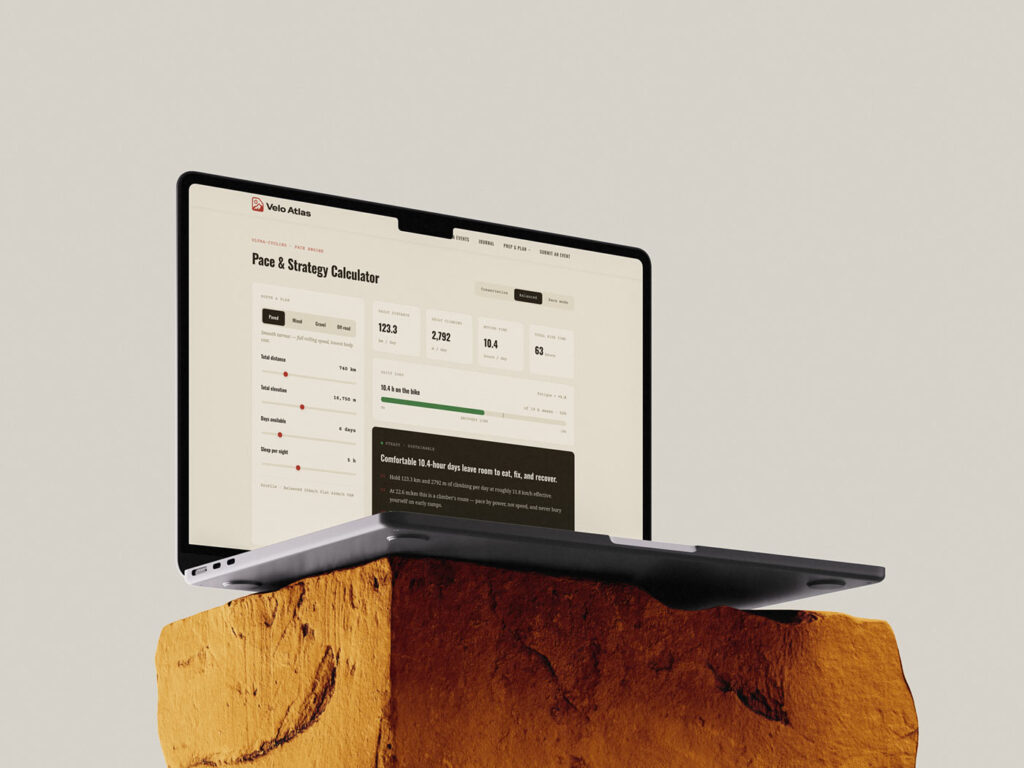
That’s the gap we built the Pace & Strategy Calculator to close. Enter your route’s distance, elevation, and terrain breakdown, choose a pacing profile — conservative, balanced, or race mode — and it models daily distance, climbing, riding time, and fatigue load together, alongside the carbohydrate, fluid, and sodium intake to match. It’s free, calibrated against real ride data rather than generic averages, and built specifically for self-supported ultra-distance and bikepacking events.
If you’re planning your next race, give it a try — and pair it with our Field Manual and packing checklist for the rest of the prep.