By Gabor
 There’s a moment, usually around midnight on day two of an ultra race, when you discover exactly what you packed wrong. It’s always something obvious. A bag that swings. A tool you can’t reach without stopping. A rain jacket buried so deep you skip putting it on and spend three hours soaking instead.
I learned most of my packing lessons at Badlands — more than 750km of remote tracks through the Spanish desert, one of the hardest bikepacking challenges in Europe. I’ve also toed the line at The GOATs, a 735km gravel race through the mountains of Portugal. My setup wasn’t what ended either race, but it wasn’t perfect either. What follows is what I’d tell myself before the start line: a practical, honest guide to packing a gravel bike for a multi-day ultra event.
The Core Principle: Weight Is Speed, But Comfort Is Finishing
Before you touch a single bag, understand the central tension of ultra packing. Every gram you add costs you watts and time. But too light and you arrive at a bivvy at 2am with nothing to sleep in, or bonk because you had no food buffer.
The sweet spot for a race like Badlands or a 500–800km self-supported event is roughly 7–10kg of total kit weight excluding food and water. Lighter is possible — elite riders often run 5–6kg — but for most people finishing their first or second ultra, comfort margins matter more than the last 500g of weight savings.
A good target breakdown:
- Sleeping system: 600–900g
- Clothing: 800–1,200g
- Nutrition buffer: 500–800g (carried, not consumed)
- Tools and spares: 400–600g
- Navigation and electronics: 300–500g
- Bags themselves: 500–700g
The Bag System: Where to Put What
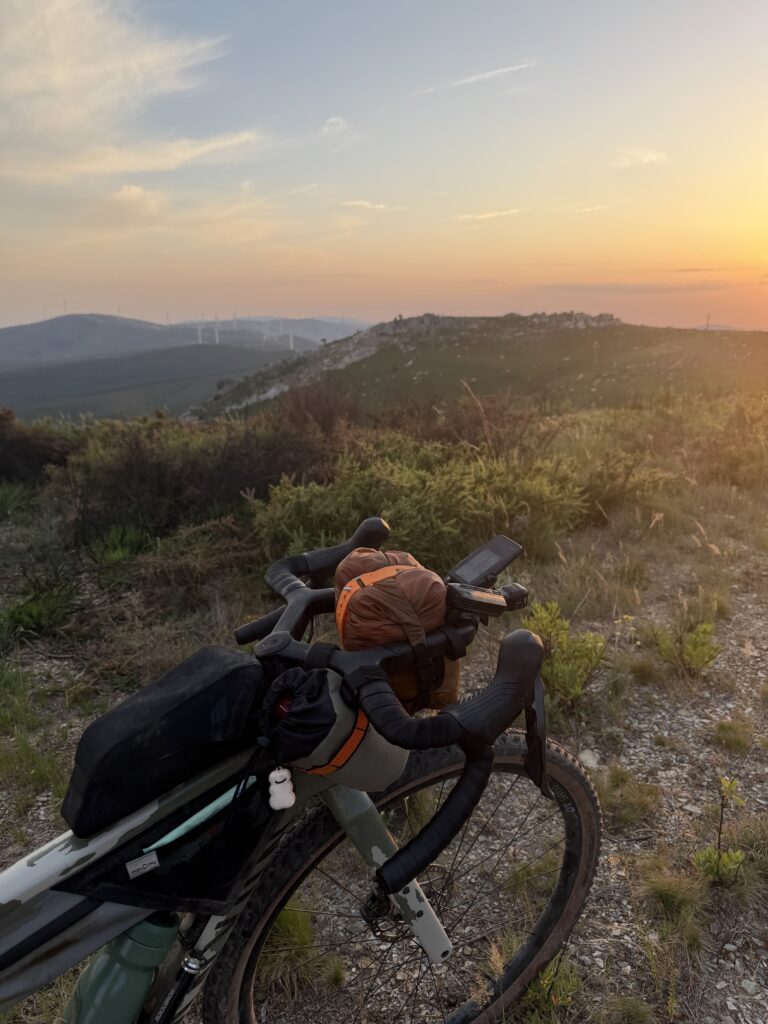
Handlebar bag (7–10 litres)
This is your largest volume. Use it for bulky but light items: sleeping bag or bivvy, puffy jacket, spare base layer. The key rule — nothing heavy goes here. A heavy handlebar bag creates a pendulum effect that makes the front wheel squirm on rough gravel descents. Seatpost bags carry weight better; handlebar bags carry volume.
Good handlebar bags: Apidura Backcountry, Restrap, Ortlieb Handlebar Pack.
Frame bag (half or full frame)
Your most stable storage — weight sits low and centred. Pack your heaviest items here: tools, tubes, pump, multi-tool, food that you won’t need to access while riding. A half-frame bag leaves room for a water bottle inside the triangle, which matters a lot on hot desert stages.
If your bike has a full frame triangle (like my Canyon Grizl), you can run a full frame bag and carry 2–3 litres of water inside the frame, but you lose bottle access while riding.
Top tube bag (0.5–1 litre)
Your cockpit. This is everything you need without stopping: snacks for the next 30–60 minutes, lip balm, phone, emergency cash, headtorch if it’s about to get dark. Zip it closed with one hand while pedalling. Anything that slows you at the side of the road costs more time than you think over 500km.
Saddle bag (8–16 litres)
The workhorse. Clothing layers, spare kit, first aid, everything you don’t need urgently. Anti-sway straps are non-negotiable — a swinging saddle bag on loose gravel is distracting at best and dangerous at worst. Some riders add a small stabilizer cage bolt to their seatpost clamp.
Stem bag / feed pouch (optional)
Useful for a secondary snack supply or a softflask. Adds a bit of aero drag but for ultra distances, convenience beats aerodynamics every time.
What to Actually Pack: The Badlands-Tested List
Sleeping
- Lightweight bivvy bag (OR Emergency Bivvy or similar) — 250g
- OR ultralight sleeping bag (if temperatures below 5°C expected)
- Sleeping mat is a personal call. Most ultra racers skip it. I did at Badlands and didn’t regret it on Spanish summer nights.
Clothing
- 2× bib shorts (one on, one drying or spare)
- 2× jerseys
- Lightweight rain jacket — compressible, waterproof, not just water resistant
- Arm/leg warmers (lighter and more versatile than a full jacket for temperature swings)
- 1× base layer for sleeping
- Warm gloves
- Lightweight buff
- 3× socks (wool if possible)
- 1× casual top for checkpoint stops (optional but surprisingly good for morale)
Tools and spares
- Multi-tool with chain breaker
- Tyre levers (2)
- Spare inner tube (2) — even if running tubeless
- Tubeless plug kit and sealant top-up
- CO2 cartridges (2) or mini pump
- Spare derailleur hanger (this one saved my race)
- Chain quick-link (2)
- Spare brake pads
- Small roll of electrical tape and a zip tie or two
- Nitrile gloves — for fixing mechanicals at 3am without wrecking your skin
Electronics
- GPS head unit — I use a Coros Dura, which I didn’t charge once across the entire GOATs race. Battery life at ultra scale is not a small thing.
- Backup USB power bank (20,000mAh for multi-day events)
- Short charging cables for each device
- Dynamo hub charging setup if your bike has one — game-changing for 4+ day events
- Rear light (always on in flash mode)
- Front light(s): one bright for night riding, one backup
Nutrition buffer
Never arrive at a checkpoint empty. Carry enough food for 4–6 hours beyond your next guaranteed resupply. I carry a combination of real food (rice cakes, dates, cheese) and race fuel (gels, bars) — the real food is for your mental health; the race fuel is for emergencies.
Personal
- Small first aid kit: blister pads, antiseptic wipes, ibuprofen, electrolyte tablets
- Chamois cream — enough for several applications per day. Don’t ration this.
- Toothbrush and small toothpaste
- Small microfibre towel
- Cash and payment card
For a complete version of this list you can save and print, use the VeloAtlas ultra cycling checklist.
The Weight Distribution Rule
Heavy items go low and central. Light items go high and at the extremes. This is non-negotiable for bike handling.
If you load your handlebar bag with heavy tools and your frame bag with soft clothing, you’ll feel it every time you descend a loose gravel track — which at Badlands, is constantly.
Practical check: load your bike, pick it up by the seatpost, and gently tip it sideways. If it falls over sharply in one direction, your weight distribution is off.
Before Race Day: The Test Overnight
Pack your full setup and do a minimum 150–200km ride overnight before your event. Not to test your fitness — you know how to ride. To test:
- Which bags need tightening after 100km of vibration
- Which items you never accessed and can leave home
- Whether your front light mounts interfere with the handlebar bag
- How long it takes you to access your rain jacket in the dark
This single test ride will tell you more about your setup than any amount of research.
What I’d Change About My Badlands Setup
In the spirit of what makes ultra advice actually useful — here’s what I got wrong at Badlands.
I packed too many clothing layers. Desert temperature swings in Spain are brutal, but I carried a mid-layer I almost never used. It just occupied space in my saddle bag and made the whole rear feel heavier than it needed to be.
My frame bag was too large. I had room I didn’t fill, which meant things shifted around. Tighter packing — or a smaller bag — would have kept everything firmer.
I underestimated small items. Cable ties, a small piece of wire, and a spare bolt for a bottle cage cost nothing in weight and saved me twice.
Plan Your Pace Around Your Kit
One thing riders don’t connect is that your packing choices affect your pacing strategy. A heavier setup means slower climbing, longer resupply stops, more time off the bike. Before race day, run your numbers through the VeloAtlas pace calculator — it helps you model realistic daily distances based on your speed assumptions and cut-offs, which in turn tells you how aggressive you can actually afford to be with your kit weight.
The Mindset Shift
Packing for an ultra isn’t about gear. It’s about decision-making under fatigue. Every time you need to stop to dig something out, every time you fiddle with a bag strap in the rain, every time you can’t find your headtorch at dusk — those are the minutes that accumulate and the frustrations that chip away at your resolve.
Pack so your brain doesn’t have to think. Every item in one predictable place. Quick access to the things you need every hour; deep storage for the things you need once a day. The bike becomes an extension of your body. The setup either supports that or fights it.
For more field-tested tips on gear, nutrition, and race strategy, explore the VeloAtlas Field Manual — built from real ultra cycling experience, updated continuously.